How VoiceClub.ai Helps YouTubers Reach Global Audiences and Increase Their Revenue
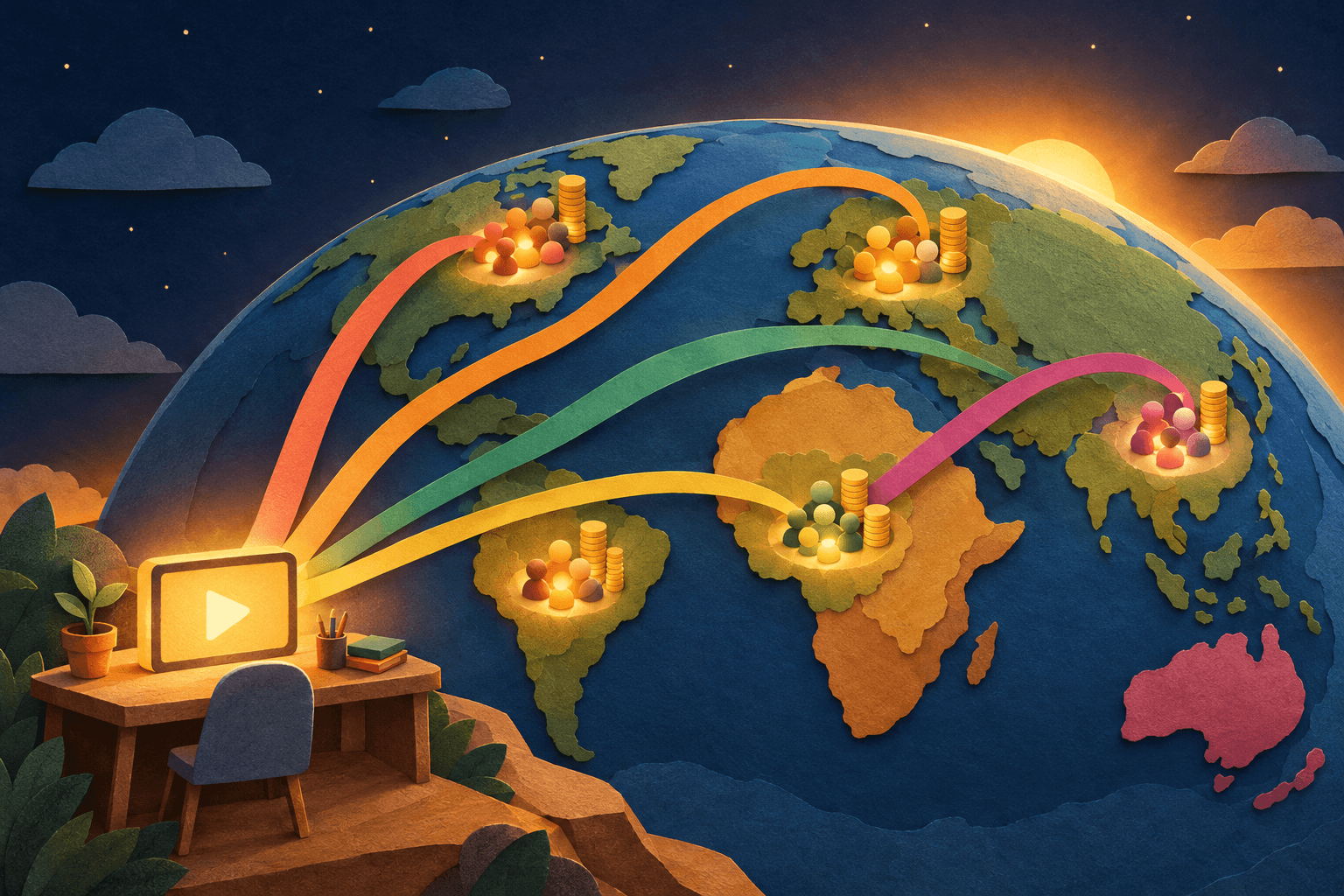
YouTubers can grow revenue without filming more: dub existing videos into new languages, keep the creator's voice and emotion, and measure each market.
By VoiceClub AI ·
AI assisted. Reviewed and approved by a human editor.
Key points
- YouTube reports that creators who uploaded multi-language audio tracks saw, on average, over 25% of their watch time come from views in a non-primary language (as of July 2025).
- Dubbing an existing video library opens new language markets without filming new videos.
- More views do not guarantee proportional revenue: viewer location, advertising demand, content category and dubbing costs all matter.
- A dub must carry the creator's voice, timing and emotion, not only the translated words.
- Start with one or two languages chosen from audience data, measure results by language, then expand.
Your next million viewers may not speak your language. YouTubers do not have to create more content to earn more: they can increase the commercial value of the videos they already have by reaching audiences in other languages.
YouTube has created an opportunity for content creators to reach audiences far beyond their home countries. However, language remains one of the biggest barriers to international growth. A creator can produce an excellent video, build a loyal audience, and attract millions of views in one language while remaining inaccessible to billions of potential viewers who speak another.
AI dubbing is changing this. By translating and dubbing existing videos into multiple languages, creators can make their content accessible to new audiences without having to record entirely new videos. More importantly, high-quality dubbing can preserve the creator's voice, personality, emotional expression, and communication style across languages.
VoiceClub.ai is developing emotion-aware AI dubbing technology designed to help creators take this opportunity further: turning existing content into multilingual experiences that can reach new audiences and create additional revenue opportunities.
Why language is a growth opportunity for YouTubers
YouTube is a global platform, but creating content in one language can limit its potential audience. A video published in English may have strong appeal in Brazil, Japan, South Korea, Germany, or the Middle East, but many viewers may prefer watching content in their native language.
Subtitles help, but they do not provide the same experience as listening to a creator speak naturally in a familiar language.
YouTube has already demonstrated the potential of multilingual content. According to YouTube, creators who uploaded multi-language audio tracks saw, on average, more than 25% of their watch time come from views in languages other than their primary language, based on data from July 2025.
Read YouTube's multi-language audio announcement
This demonstrates that international audiences can represent a meaningful growth opportunity. The question is no longer whether creators can reach international audiences. It is how effectively they can serve them.
1. Turn one video into multiple language opportunities
A creator does not necessarily need to produce more videos to reach more people. Instead, existing content can be translated and dubbed into additional languages, allowing the same video to serve audiences in different markets.
For example, an English-speaking creator could make their content available in:
- Spanish
- Portuguese
- German
- French
- Mandarin Chinese
- Japanese
- Korean
- Arabic
Each language creates an opportunity to reach viewers who might otherwise never discover or watch the original video. Rather than treating every video as content for one language market, creators can approach their entire content library as a multilingual asset.
2. Increase revenue opportunities from existing content
More viewers can create more opportunities for revenue, although additional views do not automatically translate into proportional earnings.
For monetized YouTube channels, revenue can depend on several factors, including viewer location, advertising demand, content category, audience engagement, and the type of monetization. By making videos available in additional languages, creators can potentially expand their eligible audience and generate additional advertising revenue.
There are also opportunities beyond advertising:
- YouTube advertising: Reach additional viewers who may generate monetized views.
- Brand partnerships: Offer sponsors access to audiences in multiple countries.
- Affiliate marketing: Promote products and services to new international markets.
- Digital products: Sell courses, memberships, educational materials, and other products to a wider audience.
- Subscriptions and memberships: Build communities that extend beyond the creator's original language market.
The commercial opportunity is not simply translating a video. It is expanding the number of markets in which a creator's content and business can operate.
3. Preserve the creator's voice, personality and emotions
One of the biggest challenges in AI dubbing is maintaining the creator's identity. A YouTuber's success is not based exclusively on what they say. It is also based on how they communicate.
Their humor, excitement, confidence, enthusiasm, storytelling, and emotional connection with viewers are often what make their content recognizable. A technically accurate translation can still produce a poor viewing experience if the dubbed voice sounds unnatural or fails to communicate the original emotion.
Consider three examples:
- A comedian delivering a joke needs the timing, enthusiasm, and humor to feel natural.
- A gaming creator celebrating a victory needs the excitement and energy of the original performance.
- An educational creator explaining a difficult concept needs to maintain a clear, reassuring, and engaging delivery.
Simply translating words is not enough. VoiceClub.ai focuses on emotion-aware AI dubbing, recognizing emotional expression in the original speech and regenerating speech in another language while aiming to preserve the speaker's expressive intent.
This approach helps creators maintain a more consistent personality across different language versions of their content.
Why prosody matters in emotion-preserving AI dubbing
4. Unlock the commercial value of your existing video library
Many established YouTubers have hundreds or even thousands of published videos. These videos represent years of production, investment, research, and creative work. However, their audiences may be limited by the language in which they were originally published.
Dubbing existing content can create another opportunity to distribute and monetize that work. Creators can start by identifying videos that already perform well and have potential international appeal. For example:
- Educational tutorials can attract students and professionals worldwide.
- Technology reviews can reach international technology enthusiasts.
- Cooking videos can appeal to audiences across different cultures.
- Gaming videos can attract players from multiple countries.
- Podcasts and interviews can reach new listeners beyond their original market.
- Entertainment and lifestyle videos can connect with audiences who share similar interests.
YouTube also recommends that creators consider dubbing their back catalog and prioritizing a smaller number of target languages before expanding further.
YouTube Help: add multi-language features to your videos
The important principle is to identify content that has already demonstrated audience demand and make it accessible to more people.
5. Expand internationally without managing multiple channels
Creating separate YouTube channels for every language can introduce significant operational complexity. Creators may need to manage multiple publishing schedules, subscriber communities, content libraries, comments, and analytics dashboards.
YouTube's multi-language audio feature offers another approach: creators can upload multiple audio tracks to a single video, allowing viewers to select or receive an appropriate language track. This makes it possible to maintain one central content library while serving audiences in different languages.
It can also simplify performance analysis by allowing creators to examine views and watch time by audio language. For creators who want to grow internationally, this provides a more manageable distribution strategy.
6. Choose languages based on audience demand
Not every language will offer the same opportunity for every creator. The most effective strategy is to identify where existing and potential audiences are located before investing in dubbing. Creators should consider:
- Which countries already generate views on their channel?
- Which languages are represented in their comments?
- Where is there strong demand for their particular content category?
- Which markets have audiences interested in their products or services?
- Which languages offer the best opportunity for sustainable audience growth?
For example, an English-speaking technology creator might identify demand from German, Japanese, and Spanish-speaking audiences. A gaming creator may find stronger opportunities in Portuguese, Spanish, and Korean. A cooking channel may discover substantial international interest in its recipes from entirely different markets.
YouTube Analytics can help creators understand existing audience geography and assess the performance of multilingual audio tracks. Start with one or two promising languages, evaluate the results, and expand based on evidence rather than assumptions.
7. Improve international discoverability
Making a video understandable in another language is an important first step. Helping people discover it is equally important. Creators should consider localizing other elements of their videos, including:
- Video titles.
- Video descriptions.
- Thumbnails.
- Captions and subtitles.
- Relevant keywords and terminology.
YouTube supports translated video titles and descriptions, helping videos become discoverable when viewers search in their preferred languages. A well-dubbed video with an appropriately localized title and description has a better opportunity to connect with its intended audience.
The objective is to create a complete viewing experience, not simply replace the original audio.
How to localize YouTube videos with AI dubbing
8. Build a scalable multilingual content strategy
International growth should be treated as an ongoing strategy rather than a one-time translation project. Creators can establish a repeatable workflow:
- Identify successful videos with international potential.
- Analyze audience geography and select target languages.
- Translate the original content accurately.
- Generate emotion-aware dubbed audio.
- Review pronunciation, timing, speaker identity, and emotional expression.
- Prepare translated titles, descriptions, and captions.
- Publish the additional language versions using the appropriate YouTube features.
- Monitor performance by language.
- Expand successful language markets and improve underperforming versions.
This approach allows creators to make informed decisions about where to invest their time and resources. Quality should remain a priority. A poorly dubbed video can damage the viewing experience and weaken the creator's connection with an international audience.
The AI dubbing quality checklist: what to review before publishing
9. Measure the impact on your channel and revenue
International expansion should be evaluated using measurable results. Creators should monitor more than just total views. Understanding how each language performs can reveal which markets offer the strongest opportunities. Important metrics include:
- Views by audio language.
- Watch time by language.
- Average view duration.
- Audience retention.
- New subscribers from different markets.
- Revenue and RPM by geography.
- Engagement and returning viewers.
- Conversion rates for products, memberships, and affiliate links.
Comparing these metrics before and after introducing additional languages can help creators understand the commercial value of multilingual distribution.
It is also important to distinguish between additional views and additional profit. Dubbing, production, and distribution costs should be considered when evaluating the financial return. The ultimate goal is sustainable international growth, not simply increasing view counts.
How VoiceClub.ai can help creators grow globally
VoiceClub.ai is developing an emotion-aware AI dubbing platform designed to help creators overcome language barriers while preserving the expressive qualities of their original speech.
Unlike approaches that focus exclusively on translating words and generating speech, VoiceClub.ai places particular emphasis on understanding and reproducing vocal emotions across languages. Its technology is designed around several important capabilities:
- Emotion recognition: Identify emotional characteristics and expressive intent in the original speech.
- Emotion-preserving dubbing: Regenerate speech in another language while aiming to retain the original emotional delivery.
- Natural multilingual speech: Create dubbed versions that sound more natural and engaging.
- Voice consistency: Help maintain the speaker's vocal identity across language versions.
- Content localization: Make existing videos accessible to audiences who speak different languages.
For YouTubers, the opportunity is straightforward: make existing content available to more people without losing the personality that made the original content successful.
VoiceClub.ai aims to help creators move beyond language-limited distribution and develop a more scalable approach to international content growth.
The future of YouTube is multilingual
The global creator economy is creating new opportunities for people who can build audiences beyond their geographical and linguistic boundaries. A creator who publishes exclusively in one language may be reaching only a portion of their potential audience.
AI dubbing makes it increasingly practical to distribute content across multiple languages, while advances in emotion-aware speech generation are helping address one of the biggest challenges in the process: preserving the human expression behind the original performance.
YouTube Blog: auto dubbing, explained
The opportunity is not necessarily to create more content. It is to make existing content work harder. For YouTubers, this could mean new audiences, additional subscribers, stronger international communities, and new revenue opportunities.
Your content already has a story to tell. VoiceClub.ai aims to help the world hear it.
Sources
- https://blog.youtube/news-and-events/multi-language-audio/
On average, creators uploading Multi-language Audio tracks to their videos saw over 25% of their watch time come from views in the video's non-primary language. As of July 2025. (retrieved )
- https://support.google.com/youtube/answer/13338784
Prioritize depth: Focus your efforts on one or two languages, and strive to dub as much content as you can for them. Dub your back catalog: If you have the resources, dubbing half or more of your existing video catalog can provide additional opportunities for new viewers to discover your content. (retrieved )
- https://blog.youtube/creator-and-artist-stories/youtube-auto-dubbing-explained/
Auto dubbing is available in 27 languages, and eight languages offer Expressive Speech for even more realistic sound. There are already millions of channels using auto dubbing. (retrieved )
Explore VoiceClub services.