Why Jokes and Excitement Get Lost in Dubbing—and How to Keep Them
Learn how to adapt jokes, direct expressive performances, and review timing and sound to preserve emotion in dubbed videos.
By VoiceClub AI ·
AI assisted. Reviewed and approved by a human editor.
Key points
- Emotion in a dub depends on delivery as well as translated words.
- A joke can be adapted to suit the target language and visible action.
- The original scene can guide a performer's timing and energy.
- The final mix brings together adaptation, performance, and recording.
Jokes and excitement can get lost in dubbing when the words are translated but the effect of the original scene is not carried across. A joke may depend on a particular turn of phrase or reference; an excited line may feel different if its pacing, pitch, volume, or delivery changes. To preserve emotion in dubbed videos, mark the intended joke and emotional beats, adapt lines with local-language expertise, direct the performance against the original scene, and review timing and sound in context. Testing key moments with target-language viewers can also inform revisions.
Why are accurate words only part of an expressive dub?
A line can do more than convey information: it might build anticipation, signal enthusiasm, or set up a joke. When reviewing a dub, it helps to ask both what the line says and what it is meant to do in the scene. A translation can communicate the basic information while leaving the intended tone open to a different interpretation.
Research on professionally produced dubbed content emphasizes translation quality and vocal naturalness and identifies emotion and emphasis as important features beyond the translated words. That distinction gives creators a useful review principle: assess the script and the sound of the performance together.
Read the research on dubbed speech and translation
Imagine a creator announcing a surprising result. The original performance might use a pause and a rising pitch to make the result feel like a reveal. If the dubbed line is delivered at a steady pace, the information may still be clear, but the moment may feel less like the original. This is an illustrative possibility, not a rule that every reveal needs the same delivery.
Visual fit matters too, but matching mouth movement alone does not establish whether a performance has the right energy. Netflix's dubbing guidance discusses mouth movement alongside performance energy, dynamics, volume, and projection. Treat those as connected considerations rather than assuming that a visually tidy line is automatically an expressive one.
How can you adapt a joke without losing the scene?
Start by explaining the intended effect rather than asking an adapter to translate the punchline in isolation. In a hypothetical pun, for example, the humor might depend on two meanings of one word. A direct translation is worth checking for the same effect; if the target language does not offer the same double meaning, a local-language specialist can consider another way to make the moment playful.
The same practical check applies to a rhyme or a cultural reference. Instead of assuming it will land unchanged, give the specialist context: what is being referenced, why the speaker mentions it, and how the audience is meant to react. The specialist can then judge whether to retain it or suggest an alternative for the target language.
Adaptation still has boundaries. Suppose a speaker makes a pun about a food visible on screen. A replacement joke about that food may be worth trying, while a line describing a different object could conflict with the picture. Likewise, an adapted punchline should make sense with the setup and any reaction or callback that follows.
These examples are ways to think through a creative decision, not evidence that one technique will work for every audience. Compare candidate lines in the full scene, and ask the local-language specialist to explain the trade-offs: natural phrasing, intended humor, character, visual fit, and the time available for delivery.
How can a performance carry excitement?
Rather than directing a performer to simply sound louder, listen for the shape of the original delivery. Where does the speaker speed up or pause? Which word receives emphasis? Does the pitch rise, does the energy build, or does the speaker suddenly hold back? Those observations make a more specific brief than the instruction “sound excited.”
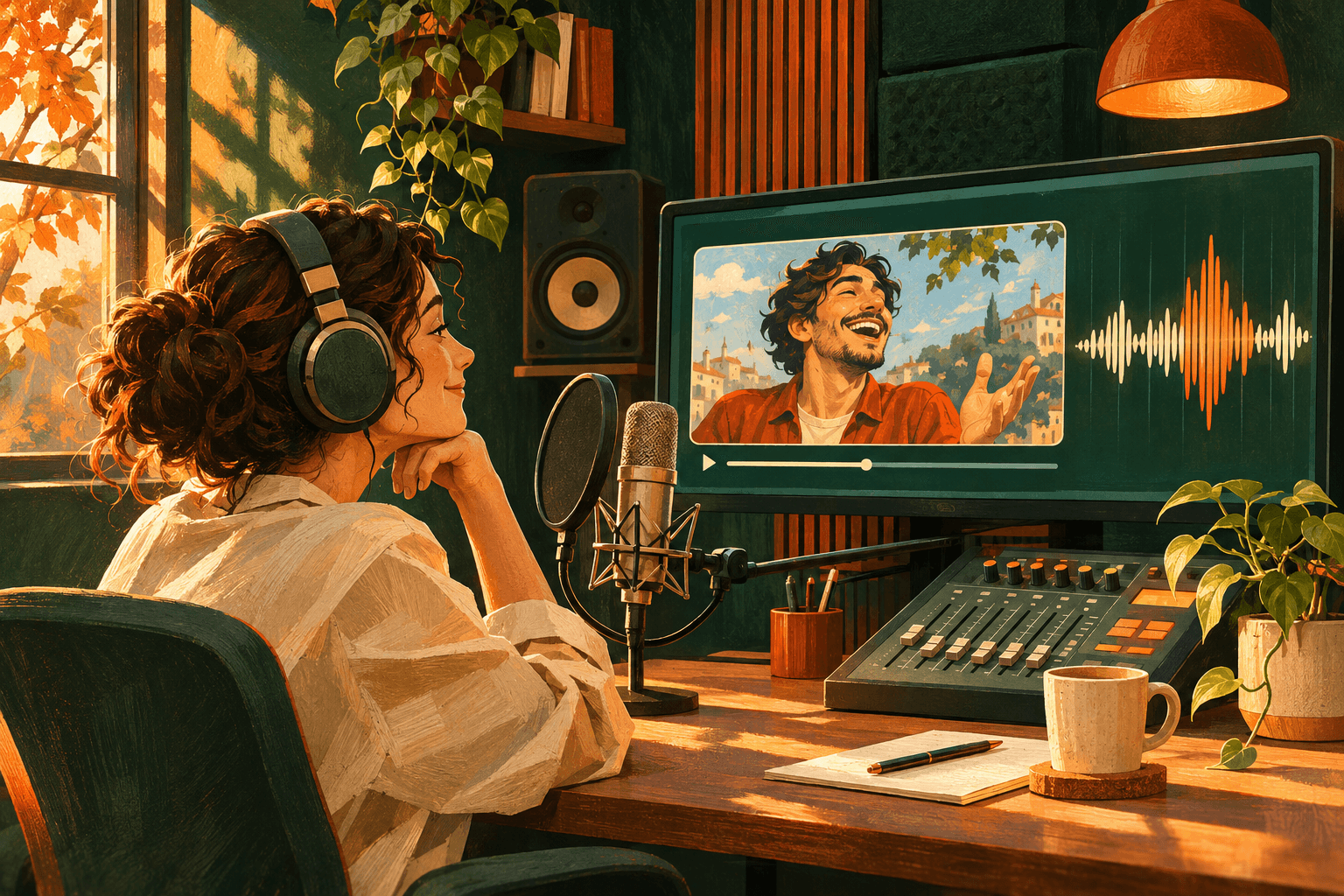
Watch the scene as well as listening to it. A gesture, expression, or cut can give the performer a cue for when to start, pause, or land a key word. The target-language sentence may have a different length or rhythm, so use the original as creative direction rather than demanding a mechanical copy of every sound.
Netflix's creative guidance recommends dry runs that consider pauses, emotions, and delivery. In practice, try playing a short section of the video while the performer reads the adapted line. Then listen back in context: does the read leave space for the reveal? Does the emphasis support what is happening on screen? If not, discuss the wording and delivery before treating the take as final.
The same questions are useful when reviewing generated speech. Listen for the intended changes in emphasis and energy rather than checking only whether the words are present. If a line sounds wrong for the moment, identify the specific beat that needs attention and revisit it as part of the wider dub.
Explore Netflix's dubbing principles for performance and timing
Learn more about emotion and prosody in AI dubbing
What workflow can help preserve the intended effect?
The following is a practical workflow for bringing script, performance, and review decisions together. It is a suggested approach rather than a guaranteed formula for humor or emotion.
- Mark key moments in the original: setups, punchlines, emotional shifts, emphasis, and pauses.
- Describe the intended effect of each moment and note any visual constraints.
- Ask a local-language specialist to adapt the lines, considering natural phrasing, scene context, and timing.
- Share the original scene and notes with performers, and try the adapted lines against the picture.
- Review the delivery, timing, and final mix together, including the surrounding reaction.
- Invite target-language viewers to watch important moments, then use their responses to decide what to revisit.
Annotations can be short. For a reveal, “anticipation builds; pause before the result; excitement peaks on the final word” gives a performer a starting point. For a joke, note whether the intended humor comes from the wording, delivery, visual action, or a combination. Include the relevant time in the video so the team can see the moment rather than relying on the note alone.
When a line feels too long for the shot, consider revisiting the wording with the specialist before asking for a faster read. A shorter line might leave more room for emphasis or a pause. Check the result against the setup, though: a concise punchline still needs enough context to make sense.
For a generated dub, keep the same scene notes available during review. Whether a line is performed or generated, the creator still needs to decide whether its wording and delivery suit the video. VoiceClub can be a starting point for exploring dubbing; judge the creative result against the specific scene and audience.
What should you check in timing and the final mix?
Review a line from before its setup through the reaction afterward, not only as an isolated voice clip. This gives you a chance to assess whether a pause suits the action, whether a punchline arrives at the intended point, and whether an excited response fits the surrounding scene.
If the target-language line finishes noticeably early or runs into the next event, consider both script and performance. A different phrase or read may fit the scene better than forcing the existing recording into place. The goal is not perfect lip-sync at any cost; it is a performance that feels connected to the visible action and serves the intended moment.
The mix deserves the same attention. Netflix describes mixing as the final pass that brings together translation, adaptation, performance, and recording. Listen to the dubbed voice alongside the other sounds in the finished scene. Can you follow the line and hear the intended emphasis? Does the key word have room to register?
Be cautious when changing a recording's duration to make it fit. Netflix's mixing guidance warns against time-stretching that introduces artifacts. If a correction harms the sound, revisit the adaptation or take and compare the options in context.
Read Netflix's mixing guidance for dubbed content
Use a dubbing quality checklist for your final review
How can you test key moments with viewers?
As an additional practical check, invite target-language viewers to watch a few important scenes without first explaining the desired reaction. Ask open questions such as “What happened here?” and “How did the speaker seem to feel?” For a comic moment, you might ask what they understood the joke to be; for a reveal, ask which moment stood out.
Use the responses as prompts for discussion with the local-language specialist and performer. If a viewer describes a different effect from the one you intended, replay the scene together and consider whether the wording, delivery, timing, or mix is worth revisiting. Avoid assuming that every difference in response has a single cause.
A small viewer check cannot establish how every member of an audience will react, and people need not find the same things funny. Its purpose in this workflow is to add another perspective before publication, not to certify that a dub will land for everyone.
The aim is not a frame-by-frame replica of the original. It is a version that lets a new audience follow the scene and experience its intended energy. Give the moments that carry the most feeling a clear brief, an expressive performance, and a review in context.
Sources
- https://aclanthology.org/2023.tacl-1.25/
Analyzing 319.57 hours from 54 professionally produced titles, the researchers emphasize vocal naturalness and translation quality and identify emotion and emphasis as important features beyond translated words. ([aclanthology.org](https://aclanthology.org/2023.tacl-1.25/)) (retrieved )
- https://partnerhelp.netflixstudios.com/hc/en-us/articles/11747624732947-Guiding-Principles-of-Creative-Excellence
Netflix’s dubbing guidance calls for matching performance energy, dynamics, volume and projection as well as mouth movement, and recommends dry runs that consider pauses, emotions and delivery. ([partnerhelp.netflixstudios.com](https://partnerhelp.netflixstudios.com/hc/en-us/articles/11747624732947-Guiding-Principles-of-Creative-Excellence)) (retrieved )
- https://partnerhelp.netflixstudios.com/hc/en-us/articles/360017944573-Netflix-Mixing-Style-Guide-For-Dubbed-Content
The guide describes mixing as the final pass that brings together translation, adaptation, performance and recording; it also cautions against time-stretching that introduces artifacts. ([partnerhelp.netflixstudios.com](https://partnerhelp.netflixstudios.com/hc/en-us/articles/360017944573-Netflix-Mixing-Style-Guide-For-Dubbed-Content)) (retrieved )
Explore VoiceClub services.